

AI tends to be argued about in narratives: it will cure cancer, it will revamp every industry, it is a bubble about to pop, or that it will kill us all. Anthropic’s recent IPO filing gives us actual numbers we can reason about. Its run-rate revenue reached $81b in Oct 26, up $10b in a month, against $33.2b booked in 9M26, and it has committed $900.9b to compute through 2045. These are some staggering numbers for a company just founded in 2021.
This prompted me to look at the economics of the entire industry through the lens my investing career has taught me. In the digital assets industry, narratives often ran ahead of the business. But every business strategy boils down to two questions: does it create value for customers, and can it capture enough of that value?
On value creation, the early evidence on AI is great. I spend hundreds of dollars a month on AI subs and API credits, and use coding agents every day. Don’t take it from me, token usage keeps climbing worldwide as well. Ascertaining value capture is harder. So far most of the debate about who captures the value has been about the companies selling the hardware - GPUs, memory, substrates, data centres - and that leg of the AI trade has since unwound as investors price in slower capex growth. Far less attention has gone to the other end: the model makers and the companies paying them.
1. Show me the gains - where AI creates value for its users
Companies that measure the impact of AI on their businesses see it pay off in three ways: they sell more, the same people produce more, and the bills they pay to other firms fall.
Sell better, sell to more
Two kinds of AI lift sales.
The first is a company’s own AI making its product sell better.
“In Q3, we launched this approach to generative retrieval on Facebook feed, driving a nearly 2% increase conversions across targeted segments. In addition, we expanded our GEM model for ads ranking to additional surfaces, driving a 1.7% increase in conversions for off-site conversion campaigns and a 9.6% increase in app ad conversions.”
Susan Li, CFO, Meta (3Q26 call)
“The number of customers using Sparky is up 70% from last year, and the customers and members who use Sparky for shopping spend 40% more per order than others who don’t. Someone recently shared with me that they asked Sparky for a weekly meal plan of healthy foods with high protein options. Within a few seconds, Sparky shared recipes and meal kits with the ability to add all the ingredients they need to their basket with one click.”
John Furner, CEO, Walmart (2QFY27 call)
The second is other companies’ AI sending in new customers, think SEO but for agents. It’s still a small channel, but it’s growing fast.
“AI traffic is up 2.6x year-over-year. Orders are growing even faster at 3.3x.”
Harley Finkelstein, President, Shopify (3Q26 call)
“Traffic to our site from AI search grew triple digits for the second consecutive quarter and continues to show the highest conversion rate of all site traffic.”
Gary Millerchip, CFO, Costco (4QFY26 call)
Same team, more output
Expert teams get more done in less time.
“And at Google, just in the last few weeks, teams across Chrome, Ads and Search have used Argon to write and optimize code much faster, shipping 35% more code with 30% fewer errors.”
Sundar Pichai, CEO, Alphabet (3Q26 call)
“In 2026, GenAI workflows have been used in roughly 300 of our titles, with the largest concentration of work in post-production. We are increasingly leveraging these tools to deliver higher quality output more quickly and at a lower cost than traditional methods.”
Netflix (2Q26 shareholder letter)
“I work with the AI-guided White Light Robot inspection system, adding a second set of expert eyes to deliver repeatable results in about half the time-helping turn parts faster and improve service turnaround times for our customers.”
Sam Blazek, GE Aerospace, Ohio (GE Aerospace AI page)
Cutting service provider bills
The savings companies credit to AI are cuts in what they pay external service providers.
“These increases were partially offset by a $26 million decrease in professional and third-party service costs due to lower agent contact volume resulting from increased use of artificial intelligence (”AI”) in community support.”
- Airbnb (3Q26 10-Q)
“Real-time, physically accurate 3D technology such as the NVIDIA Omniverse development platform, is helping Unilever to create digital twins of its products, producing product imagery two times faster, 50% cheaper, and leading to 100% brand consistency.”
- Unilever (press release, 18 Mar 25)
2. Generalists first, specialists next - value capture by applications
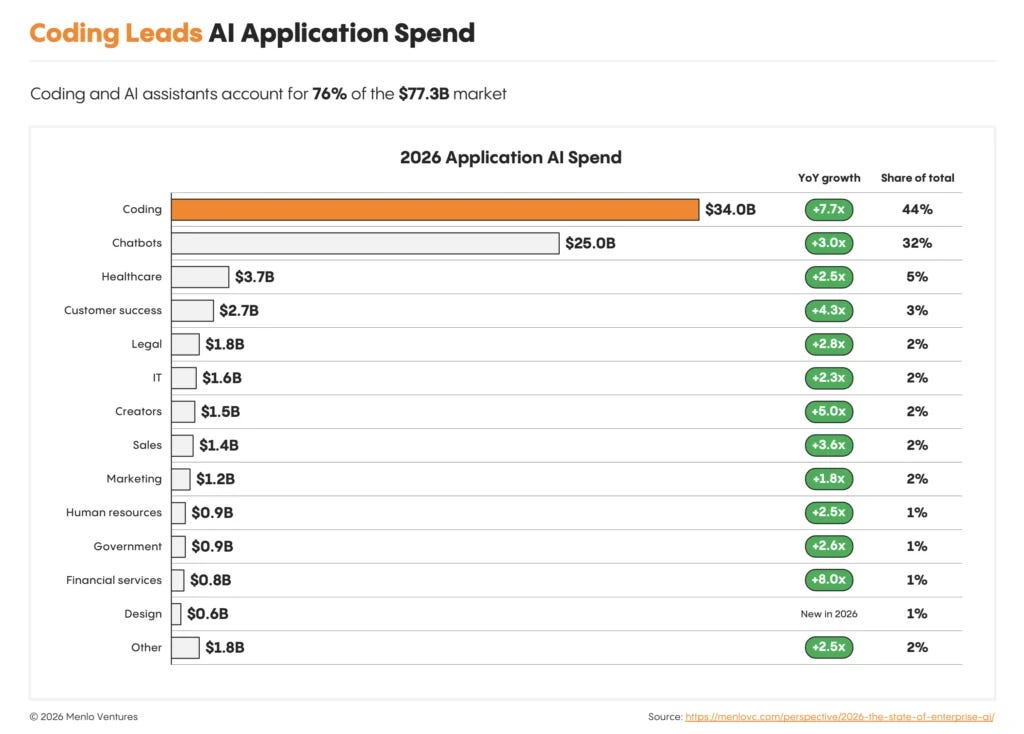
Coding tools and chatbots, the general-purpose end of AI, already take 76% of what companies spend on AI apps in 2026, and most of that goes to the labs’ own products. What a generalist tool doesn’t come with is the plumbing: access to a company’s system of records, and the nuances of job-specific workflows. Specialist tools built for a single function or industry bring both. That long tail is the next frontier of AI growth.
General-purpose tools lead the spend
Coding is where companies spend the most on AI, by a wide margin - $34.0b in 2026. Chatbots come next at $25.0b. Together they make up 76% of the $77.3b companies spend on AI apps, and the labs’ own apps take $40.0b of it, with Claude Code and Codex alone at $24.0b.
Coding came first partly because it is what language models are best at - software programs are deterministic and verifiable, moreover GitHub holds a vast supply of working examples to learn from.
Specialists by function
Specialist tools are smaller, but a handful of startups that sell services catered to specific functions have passed $100m a year in run-rate revenue. Moreover, established software firms are also introducing AI-enabled products.
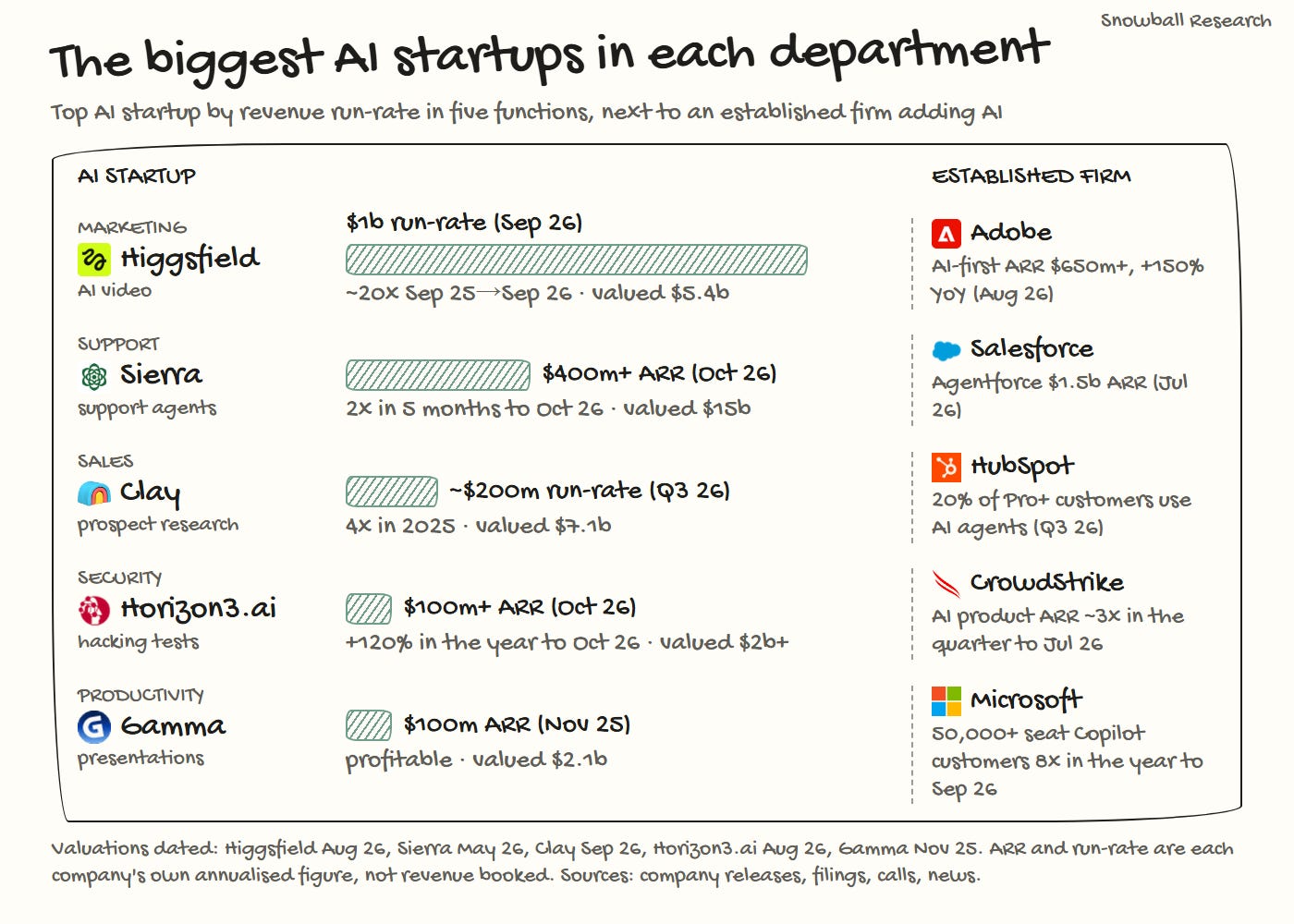
Higgsfield reached a $1b run-rate (Sep 26) making videos for marketers, and Sierra reached $400m of ARR (Oct 26) by helping to answer customer queries, 2x in 5 months.
The established firms are growing their own AI alongside rather than losing out: Adobe’s AI-first products grew >150% YoY (qtr to Aug 26) and Salesforce’s agents are at $1.5b of ARR as of Jul 26.
Specialists by industry
Meanwhile, startups serving specific industries are growing fast, with established firms also innovating with AI.
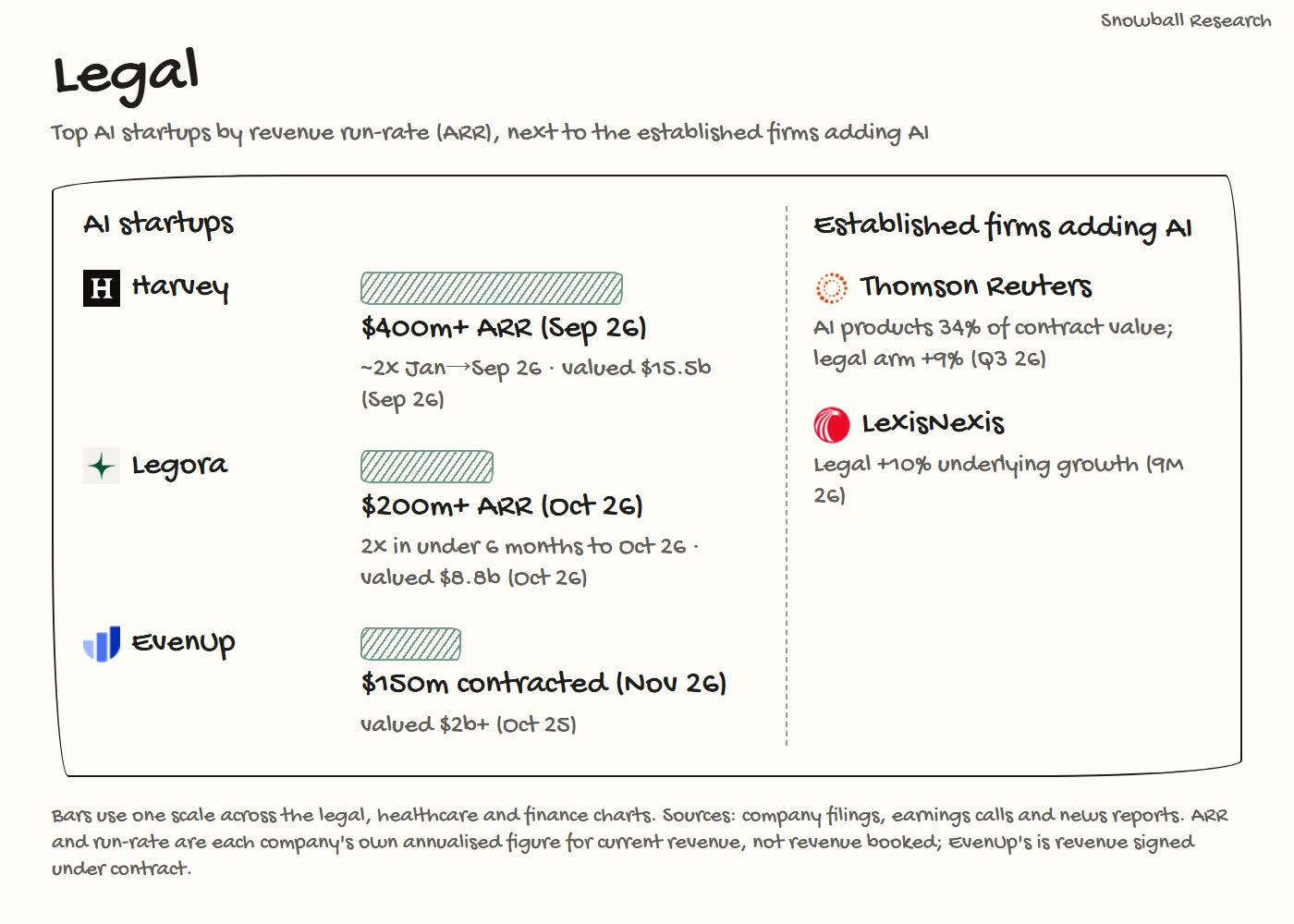
In law, Harvey reached $400m of ARR (Sep 26), 2x in 8 months, and a third of Thomson Reuters’ contract value now comes from AI products (3Q26).
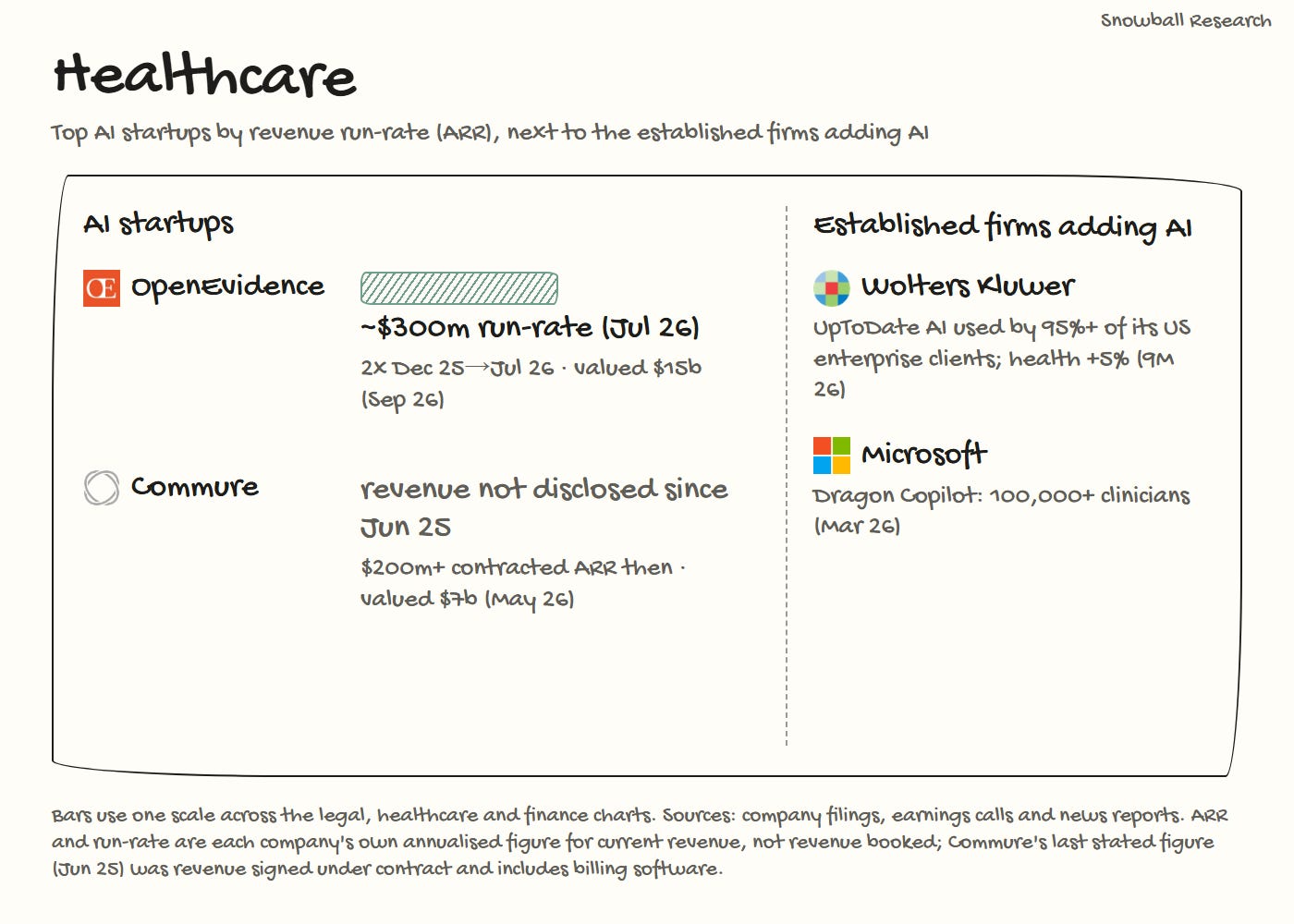
In medicine, OpenEvidence reached a ~$300m run-rate, and over 95% of Wolters Kluwer’s US enterprise customers use its AI (Nov 26).
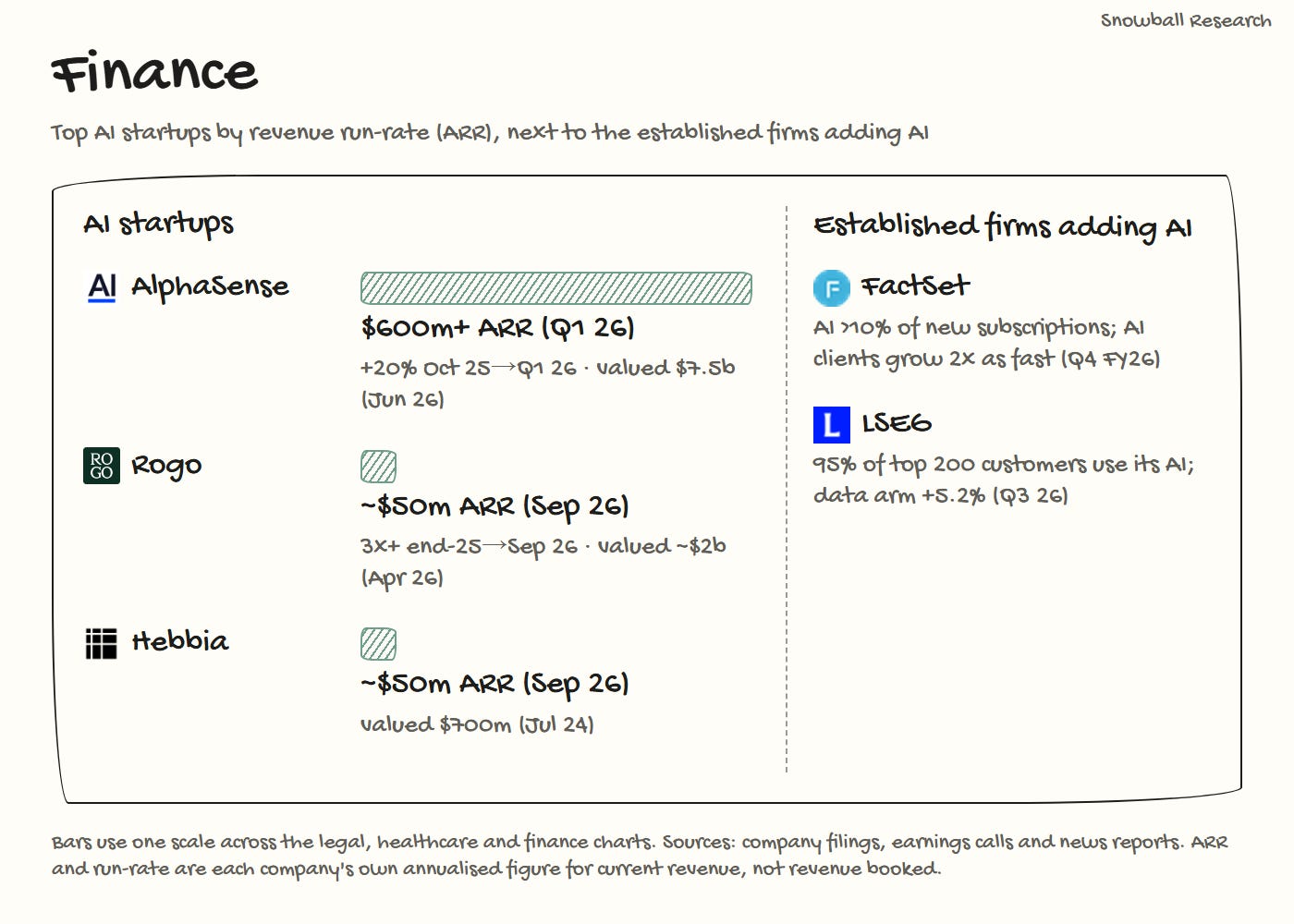
In finance, Rogo passed $50m of ARR (Sep 26), and AI made up at least 10% of FactSet’s new subscription value (qtr to Aug 26). The startups are adding to the market more than taking it.
Systems of record and expert data
An agent is only as useful as the data it can reach, and the companies that store and organise that data are growing faster. Databricks’ AI products reached a $1.7b run-rate (Jun 26), about a quarter of the company’s total, which passed $7b (Aug 26), +80% YoY. Snowflake’s product revenue grew 37% YoY in the qtr to Jul 26, its third quarter in a row of rising growth, which its CFO credits partly to “a meaningful step-up in AI revenue“.
The labs need data too, and much of it comes from people. Mercor, which hires domain experts to train and grade AI models, passed $2b gross run-rate (Jun 26), 2x in 4 months. Handshake’s AI-training business reached a ~$1b gross run-rate (Apr 26).
Personal agents and new consumer behaviours
Normal folks are not accustomed to having a personal assistant. Now the big labs are all handing one to consumers, to book travel, keep a calendar, clear out forgotten subscriptions and do the shopping.
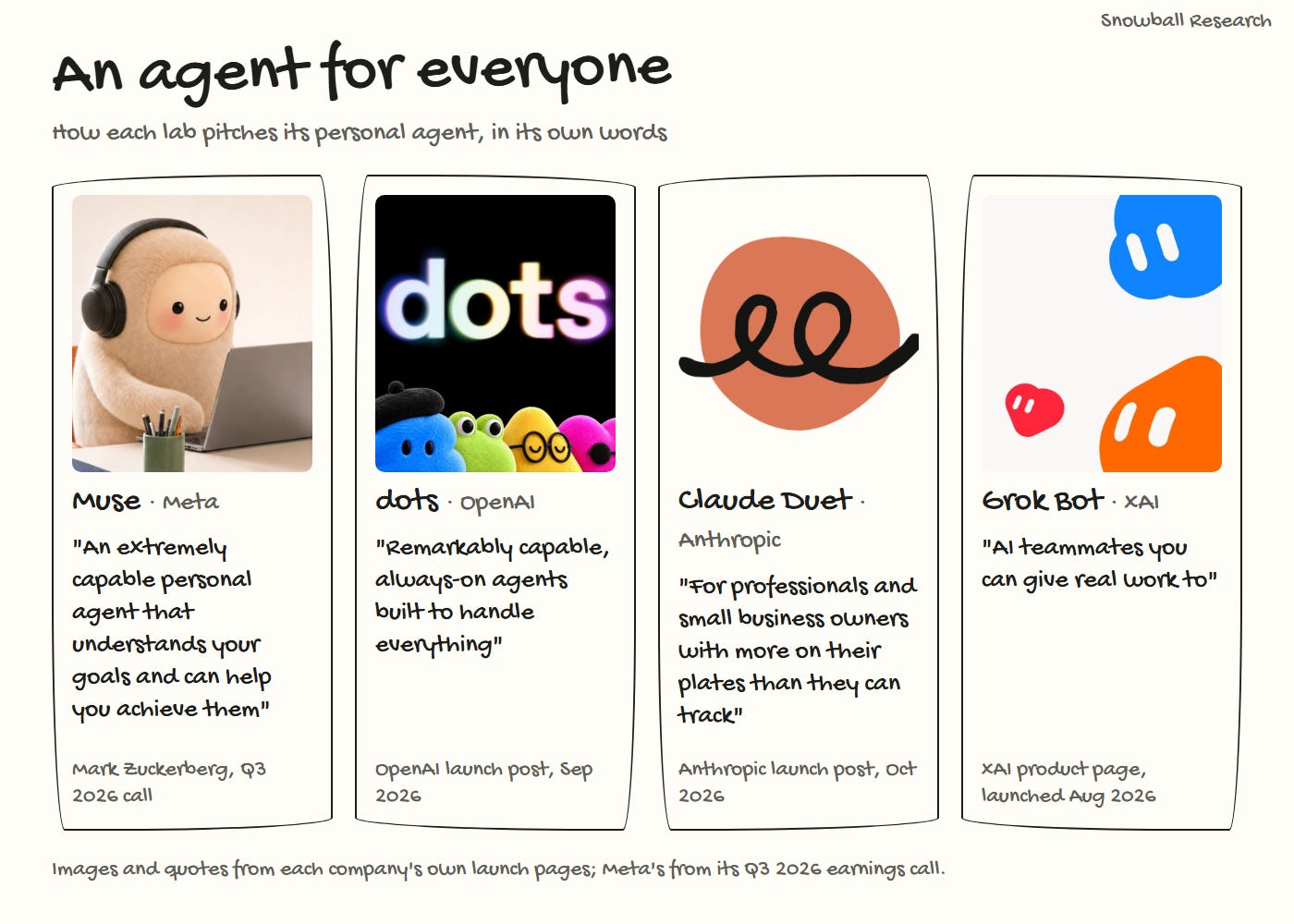
Shopping comes first. More than a quarter of Muse’s users shop through it, with an average order over $200, and in its first week Meta “had to work with Stripe to raise credit limits since the volumes were above what any of us expected”. That said, adoption is still early: in one of its busiest weeks of 3Q26, Uber took only 500 food orders and 4 rides from AI agents out of 320 million trips.
Whether the labs monetise personal agents on a standalone basis is still open, but Meta has gone furthest. Meta wants a cut of the value it creates: a fee on purchases Muse helps complete, and possibly a fee when it saves you money. Heavy users can subscribe for better models. Meanwhile, Anthropic, OpenAI and xAI bundle their personal agent offerings into subscriptions.
3. Open labs win token share, closed labs win wallet share - value capture by labs
Open-weight models now carry most of the tokens, but closed models still take most of the wallet share.
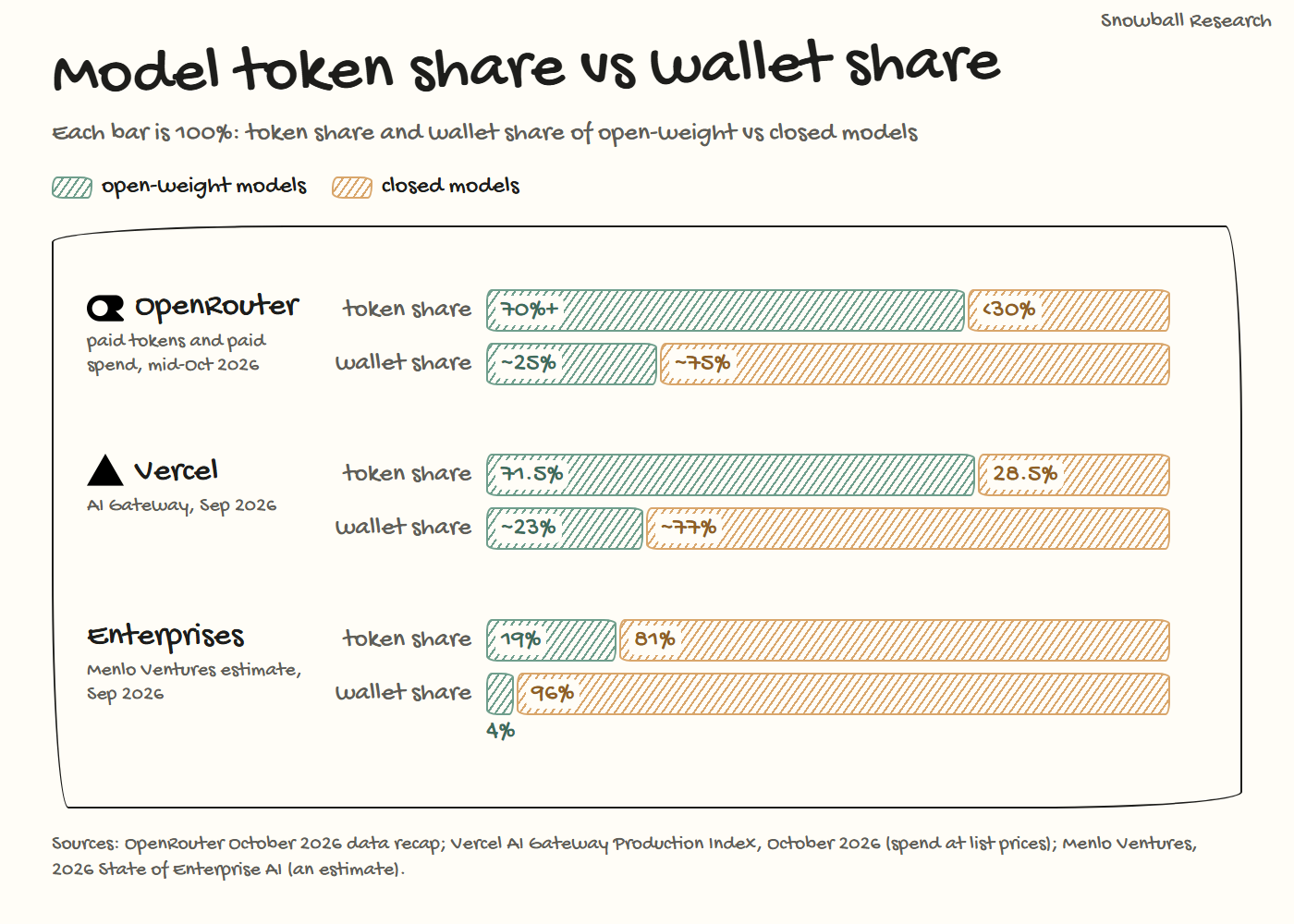
This comes down to the fact that open-weight models are much cheaper to run. On Artificial Analysis’s tests in Nov 26, Kimi K3.1 Pro scored 46 on its intelligence index (the highest for open weight models) for $3.68 a task, against 65 for $26.54 from Claude Fable 5.2 (max), the top closed model - about 7x the cost for a 41% higher score.
Who gets paid and how much depends on whether the sale was done via first party or third party channels.
The lab books the revenue
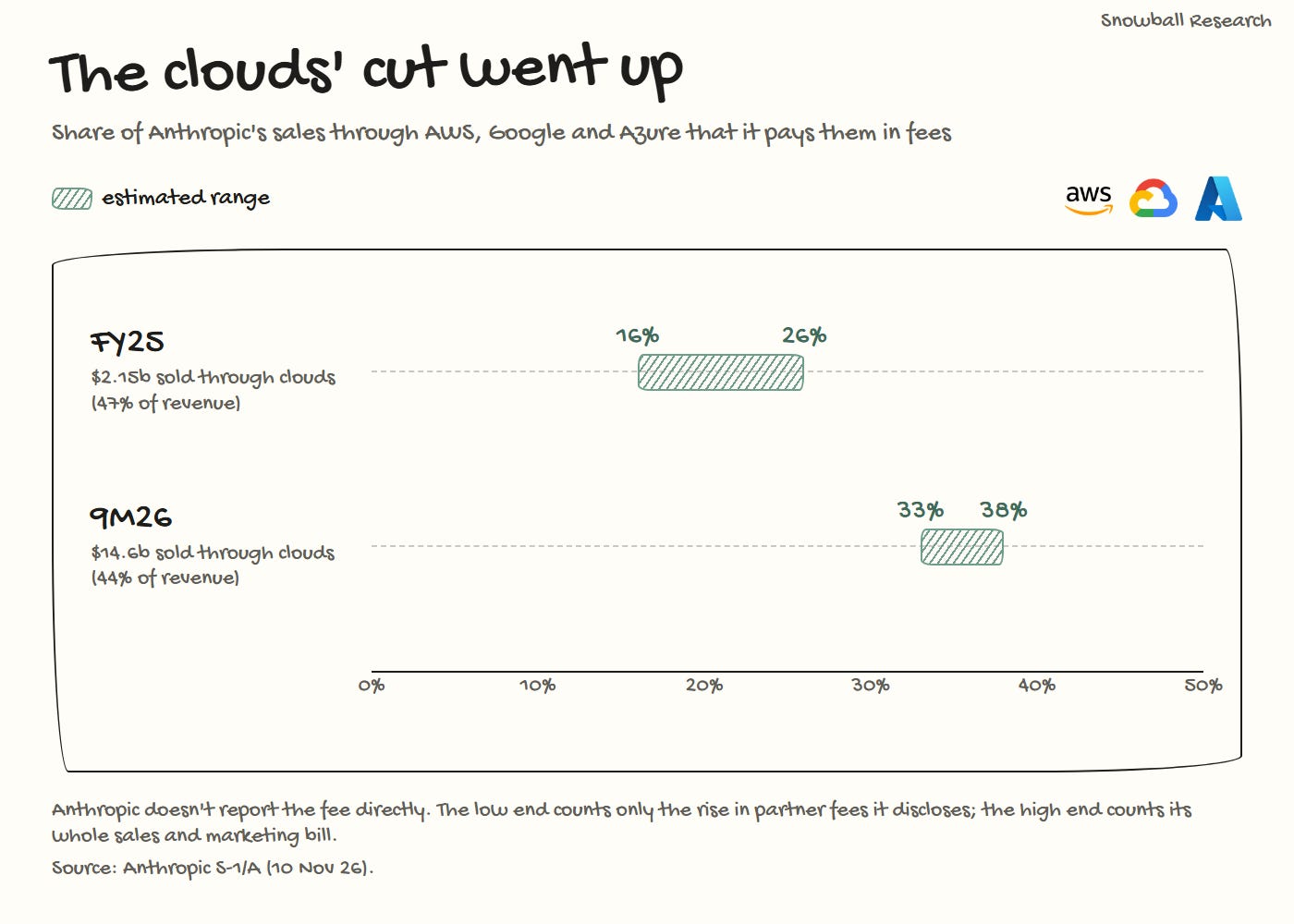
Every lab monetises on a first party basis broadly in two ways - through an API, or a flat subscription. Anthropic sold 56% of its revenue directly in 9M26 and 44% through cloud marketplaces such as AWS, Azure and GCP, where it still sets the price and holds the contract, and pays the cloud a partner fee.
Open labs also make most of their money from their own sales. In 1H26 Z.AI made 86.5% of its revenue from its API and coding subscriptions, and Moonshot’s head of enterprise said API calls made up 70% of its B2B revenue (Jul 26).
The cloud host books the revenue
Anyone can serve an open model. But the lab gets paid only if its licence or a deal with a third party (the cloud host in this case) says so.
Under a permissive licence like MIT, any cloud host can sell the model with zero kickback to the lab. This is the case for DeepSeek’s models. Resultantly, such labs would need to compete with other cloud hosts (eg. providers listed on OpenRouter), on price, speed and where the data goes. While DeepSeek’s own service is the cheapest per task, third-party hosts tend to be faster and fail fewer requests. Hosts also let buyers choose where their data is stored, which matters where privacy rules limit sending personal data abroad. DeepSeek’s privacy policy says it stores users’ data in China, while outside hosts can run the same model in the buyer’s own region.
However, open labs have started writing licences and deals to boost value capture from cloud hosts. Kimi K3’s licence makes any API seller with over $20m of group revenue a year sign a deal with Moonshot. Mistral’s license is stricter - anyone selling Mistral Large 4 as a service needs a commercial licence. Amazon shares revenue with Moonshot, and Microsoft sells Mistral Large 4 on Foundry, which under Mistral’s licence requires a commercial deal. Meanwhile, Z.AI’s GLM 5.3 licence asks only for a security review from sellers with over $10b of revenue, yet Amazon shares revenue with Z.AI anyway.
4. Margins vs capital intensity - the economics of selling tokens
Selling models has good unit economics. Serving margins already show where profits could settle, and usage is still compounding. But training new models costs a fortune, and it never stops, because each lead lasts only months before rivals catch up.
Whether it stays a good business comes down to four things: what work each model is worth paying for, how much margin a lab keeps, where its growth comes from, and whether revenue arrives in time to pay for the compute. The jury is still out on this one.
“I recognize that Anthropic has work to do in creating stickiness, but I can visualize ways in which Claude agents, twinned with client data on customers and employees, can become sticky, allowing the company to preserve its pricing power and market share.”
- Aswath Damodaran, NYU Stern (26 Oct 26)
“Customers demonstrated the willingness to base their model-choice decision on something other than pure performance, namely, data retention policies… current model capabilities are ‘good enough’ for customers to not do whatever is necessary to get access to the cutting edge… Pure capability no longer translates directly into a moat.”
- Ben Thompson, Stratechery (21 Sep 26)
Different strokes for different folks
Just like how you probably would not hire a Michelin chef just to cook you an omelette, you probably don’t need a frontier model for routine work.
The closed frontier models earn their price on complex, multi-step work. Stripe told Anthropic that Claude Fable 5 carried out a migration across its 50-million-line codebase in a day, work that would have taken a team over two months by hand. Moreover, OpenAI’s mathematicians claimed their AI agents had cracked Navier-Stokes, one of the six unsolved $1 million Millennium Prize problems.
For routine work, a cheaper open model suffices, and companies keep the frontier for the exceptions. Airbnb built its customer-service agent on Alibaba’s Qwen, which Brian Chesky called “fast and cheap”. Coinbase moved its default models to Z.AI’s GLM and Moonshot’s Kimi, and Brian Armstrong says its AI bill halved even as usage kept climbing, with engineers still free to pick a frontier model when they needed one. Revolut self-hosts its own GLM models, the default for its roughly 2,000 engineers, and says its AI coding bill fell by about 90%.
Profitability at scale
Selling tokens has been a profitable business on a unit economics level thus far - for the closed labs and increasingly so for the open labs as they continue to gain scale. In 9M26 Anthropic’s margin on serving its models was about 67%, after subtracting out the clouds’ cut on its marketplace sales and the cost of serving free users.
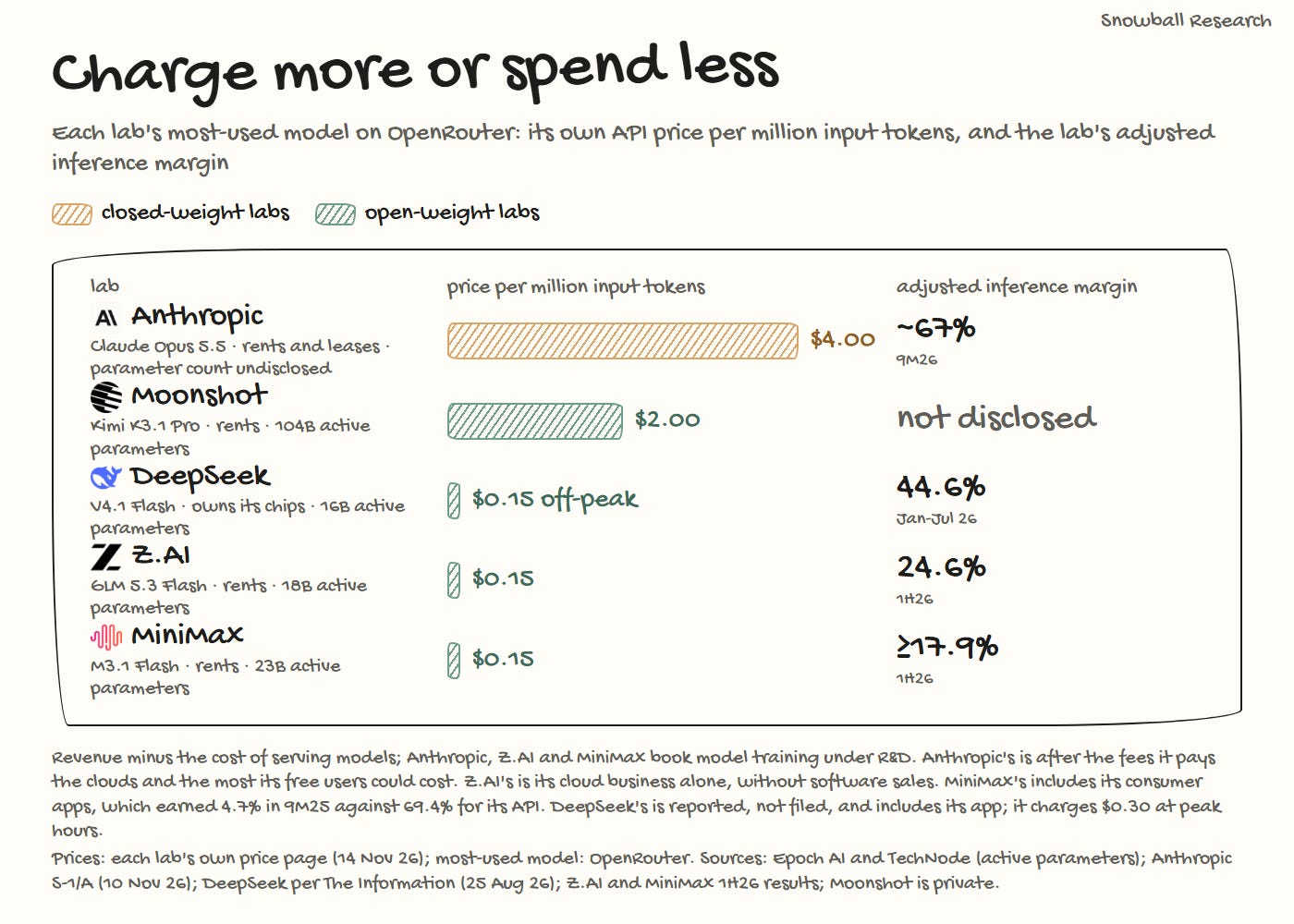
The open labs are at a lower price point, so they have some flexibility on working with the different drivers of operating leverage - pricing, cost structure and scale. DeepSeek owns its chips, which means it could retain more margin at scale. Z.AI rents capacity, but recent results show operating leverage at work. At their scale, much of the cost of serving its API is fixed, so as token usage grew ~40x in 8 months (to Aug 26), the API’s gross margin went from −0.4% in 1H25 to 24.6% in 1H26. As open labs continue to gain token share, their margins could rise as fixed costs are spread across more tokens.
Price versus volume
The trajectory of pricing strategy for the two groups are diverging. The leading open labs are raising prices, and testing whether rising token use and the shift to open models carry them through. The closed labs are cutting theirs.
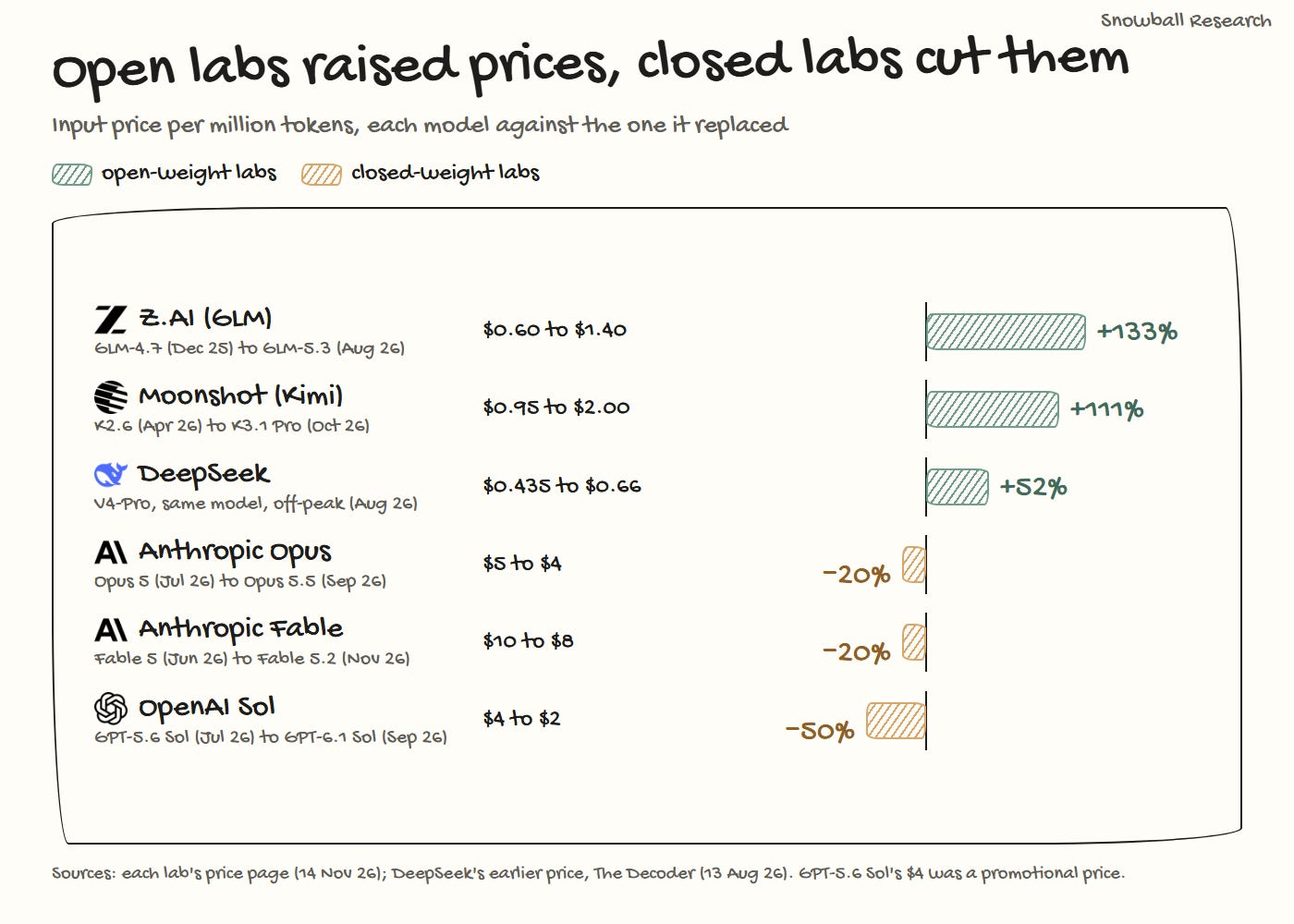
If it works, the open labs grow on both price and volume. Z.AI has done both: its token usage grew over 40x in 8 months (to Aug 26), while its average API price doubled over the same period.
On the other hand, the closed labs have to grow on volume instead. AI usage has been incredibly sticky thus far - Anthropic boasts a net revenue retention of about 900%. More volume growth can come as specialist apps continue to gain traction, since they run on the labs’ models.
Capital: the elephant in the room
Serving margins leave out the biggest cost: training new models, which the labs book under R&D. And training never stops, since each lead on the frontier lasts only months. Even after a year of breakneck growth, R&D still ran at 0.6x revenue at Anthropic (9M26) and 2.2x at Z.AI (1H26).
The closed labs cover this by ordering compute years in advance. Anthropic has committed $900.9b, and $70.7b of it is due within a year (from Sep 26) - close to its whole ~$81b run-rate. If its quarterly growth eased from 30% > 25% > 20%> 15% over the next four quarters, revenue would reach ~$121b - just enough to keep compute at today’s ~58% of revenue. And growth has already slowed from +144% (2Q26) to +47% (3Q26) a quarter. Given that these contracts are mostly non-cancellable, if revenue does not grow as quickly, as Dario himself put it - “if you’re off by a couple years, that can be ruinous”.
The open labs do so as well. In 1H26, Z.AI had RMB 1.65b of prepayments, mostly to reserve future compute, up from RMB 0.21b in Dec 25. Investors are still backing it, with ~RMB 62b raised from Jul to Sep 26 via equity and convertible bonds.
While the margins show what these businesses could earn in the long run, the short to mid term compute bills need to be funded. This could weigh on free cash flow generation over the next few years.
5. Open questions
Can enterprises show a positive return on their AI spending? Most say AI pays off, but few can prove it. In KPMG’s survey of senior leaders in 3Q26, 89% report measurable value from AI, yet only 12% consistently weigh that value against what it costs, and 10% say they have reached established returns. Companies also spent far beyond their plans: by Menlo’s estimate, the average enterprise spent 4.7x its FY25 level in FY26, against a planned 1.9x. If the returns stay unproven, that spending is open to cuts in a downturn.
Will the labs compete with the specialist apps? They already do. Anthropic sells Claude for Financial Services, Healthcare, Life Sciences and Legal, with data connectors pre-loaded, and OpenAI sells models built for law and life sciences. The test is whether specialist apps can drive retention via workflow integrations now that the labs sell to the same customers.
Will the open labs close the gap between token share and wallet share? There are promising signs. Raising prices and signing revenue-share deals with cloud hosts bodes well for unit economics, but it works only if their token share holds as prices rise.
Will enterprises run the models themselves? Some already do, like Revolut. These companies self-host open models for a variety of reasons - to cut costs at high volume, to keep data in-house, or to tune a model for customised work. No lab, open or closed, gets paid for the tokens a company serves itself. The more companies do this, the more tokens get consumed without any lab getting paid. It would be interesting to see labs trying to monetise via this channel.
TLDR
Value creation in AI is driven by increased revenue, increased productivity or increased cost savings
Value is captured by applications - This has already scaled to generalist coding agents, and is starting to branch out to long-tail domains
Value is also captured by model labs, as selling tokens turns out to be a great business.
Frontier models have a solid footing on complex tasks, while open models are taking token share across the board; But capital requirements are enormous across the board
Open questions - whether companies can prove a return on AI, whether the labs’ own tools compete with the specialists, whether the open labs’ price rises stick, and whether self-hosting eats into labs’ paychecks
It was a ton of fun writing this article, but there’s far too much to cover in one piece, and I feel like I’ve barely scratched the surface. The next few articles will likely cover established software firms that are making a push with AI-enabled products, cloud service providers and on-prem deployments.
Thanks for reading.
Bryan @ Snowball Research
Important Disclosure
This publication reflects my personal opinions and is provided for general information and education only. It is not financial advice, a research report, a recommendation, or a solicitation to buy or sell any security, derivative, fund, or digital asset, and it does not take into account your objectives, financial situation, or needs. I am not licensed by the Monetary Authority of Singapore to provide financial advisory services under the Financial Advisers Act.
Investing involves risk, including the possible loss of principal. Past performance is not indicative of future results. Digital assets can be extremely volatile and may offer limited regulatory recourse; you could lose all the money you invest. Information herein is believed accurate at publication but may be incomplete or change without notice; I make no warranty and have no obligation to update this content.
I may hold positions in assets mentioned, and may change those holdings at any time without notice. Nothing here should be relied upon as a basis for investment decisions; please do your own research and consult a licensed financial adviser before acting.